.png)


A Call to Write Our Own: Lessons from Aphelionite See Yong Song
Written by: Thorsten Lee Rui Zhe (1A1, 2026)
On 14 August 2026, during my Aphelion Consortium Assembly, Mr. See Yong Song came to share some valuable and enriching advice with us. When Mr. See’s presentation began, I knew I was in for an inspiring 20 minutes.

I fondly remember how he started his Google Slides: “yongsong yaps, who’s this unc?” What was special about this was how deeply it resonated with and connected my friends and me. After learning that he was a Hwa Chong alumnus and the Vice-Chairman of the 14th Aphelion Council, I began to see him not just as a speaker, but as one of my great-great-great seniors — someone who had helped pave a path for all of us juniors to follow.
He then told us how he had started his journey just like all of us, as an aspiring Aphelionite. But what he did differently was learn to walk and write his own path. He took up meaningful positions and became an integral part of the Hwa Chong community. Not only did he become a councillor in High School, but he carried the same mindset into College too — that he could enact change, no matter what.
Something else he shared openly, and which we did not expect, was that his grades were good, but not the best of the best. He was not ashamed of this, though. Instead, he saw it as an important part of his identity. What he wanted to drive home was that, as a Hwa Chong student, grades did not have to make up our entire lives.

Within the Hwa Chong community, there are many other uncharted facets and experiences that we can explore. There are leadership opportunities, such as becoming a council member or joining the Organising Team of an event. There are also passions and hobbies, such as CCAs and external activities that we organise with our friends. As the Vice-Chairman of a Council and the secretary for various events, Mr. See had many valuable experiences that he would have missed out on had he chosen to ignore these opportunities. Today, he is a lawyer and an associate at Baker McKenzie, one of the largest multinational corporate law firms in the world.

Would he have been able to pursue his dreams in the same way if he had not explored these other interests in school and walked different paths?
At the end of the day, what Mr. See wanted to drive home was that we need to discover ourselves and decide what kind of stories we want to write. The only way to grow is to take our past and present experiences, connect the dots between them, and piece them together to create a unique, never-before-seen identity of our own.
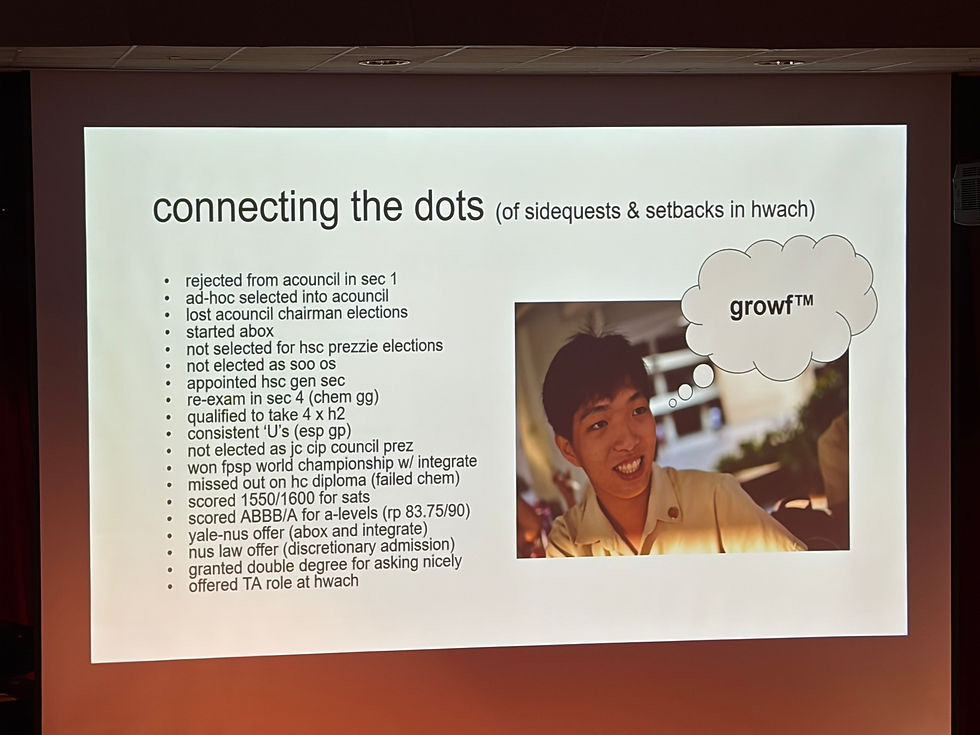
Therefore, we should hold on to the memories we have, cherish them, and use them to move ourselves forward in interesting directions we have never known. One of the most inspiring things he shared was: “If we make sense of who we are, we could then have a clear sense of direction.”
Towards the end of his speech, he left us with an inspiring quote by a former principal:
弱者,等待机会。
强者,争取机会。
智者,创造机会。

To me, this means that some people simply wait for opportunities to come to them, while others recognise and seize opportunities to improve themselves. But nothing beats someone who takes the initiative — a leader and role model who does not wait for opportunities to appear, but creates meaningful experiences and enacts change.
All in all, going back to Mr. See’s sharing, what he wanted to tell us was simple: go for the countless experiences presented to us. Nothing is stopping us, so why should we miss out on these chances? Why do others take these opportunities while we simply walk past them?
Let’s learn to strive for these memories and create some more for others down the line, making them an unforgettable part of our lives.
Looking back at my own experiences after his speech, I realised that this was something I needed to deeply understand and treasure. As a student leader in primary school, I had looked forward to seeing how this would translate into secondary school leadership positions. However, I was initially hesitant because I was not sure if I could do it.
After reflecting about Mr. See’s speech, I knew that I should take the initiative to sign up as a councillor as soon as I could. I became curious about what kind of cherished memories I could make as someone who serves the school, and perhaps how these experiences might help me in my future career too.
These extracurricular activities are opportunities that I should not miss out on. Ultimately, this ties back to Mr. See’s speech: other types of experiences help us discover who we truly are. They reveal our capabilities, responsibilities and potential to strive towards becoming the best versions of ourselves.
Everyone has their own strengths, but many of us have yet to discover them. Therefore, we should use these rewarding experiences and memories to develop ourselves and continuously improve.
These experiences are what make me, uniquely me.


