.png)


Content Creation in a Digital, AI World: Studio Symposium 2026
- Apr 8
- 3 min read
Updated: Apr 30
Written by: Ooi Khe Sheen (26S6F) and Yeo Yu Xiang (25S67)
Edited by: Lei Yanyang (25S61)

Organised by Hwa Chong’s Studio Ardent, the 5th edition of the Studio Symposium, held on 20 March 2026, brought together over 100 participants from five schools at LT3 for a day of discourse and fellowship. Media professionals and students exchanged perspectives centred on the theme: “Content Creation in a Digital, AI World”.

The day commenced at 9 a.m. with an introductory address by Studio Ardent’s President and Vice-President, followed by icebreaker activities across the various venues. Games such as Speed Dating and Human Knot filled the rooms with laughter as participants bonded over shared interests, fostering a sense of camaraderie and setting an energetic tone for the day ahead.
Next, participants gathered at the lecture theatres for the inter-school sharing segment. Representatives from the multimedia clubs of Anglo-Chinese Junior College, Hwa Chong Institution (College Section), Hwa Chong Institution (High School Section), NUS High School, River Valley High School (Junior College), and Temasek Junior College shared their experiences by highlighting three common motivations: serve the school community, capture memories, and tell authentic stories. Aesthetically, they also emphasised the value of original storytelling and the portrayal of emotions, qualities which AI still falls short of replicating.

These pieces of sharing were followed by a keynote address by Mr Jeremy Lee, Senior Multimedia Producer and Project Manager at Reuters Plus. Speaking on the theme “AI Won’t Take Your Job—But Someone Who Knows How to Use It Might”, Mr Lee offered a sobering perspective on the place of AI in creative work. Drawing on his experience in large-scale sports coverage, he introduced the notion of the “AI efficiency trap”: the illusion that AI can seamlessly perform tasks when in reality, its output still requires careful checking and refinement.
While acknowledging AI’s usefulness in automating menial tasks, he stressed that creative work, defined by qualities such as ethics, taste and originality, remains at its core deeply human. “Stay paranoid,” Mr Lee advised. Rather than becoming dependent on AI, he encouraged students to approach it with discernment, never taking its output at face value without critical evaluation and rigorous editing. Ultimately, his message was clear: powerful as AI may be, it cannot replace our humanity.

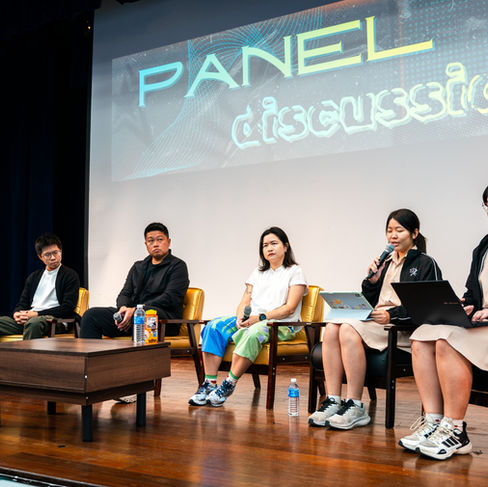


Speakers address questions from the audience during the panel discussion. Studio Ardent/Junhong
The final segment was a panel discussion. Mr Jeremy Lee was joined by Mr Ian Mun, wildlife and conservation filmmaker and photographer, Mr Goh Si Wei, former athlete and sports photographer, and Ms Geraldine Cheng, Manager of Education and Programmes at Objectifs Centre for Photography and Film. The dialogue explored issues of authenticity and trust in an AI-driven landscape, underscoring the importance of intention, lived experience in storytelling, and the human touch in crafting meaningful media. The panellists also offered practical insights while addressing the ethical considerations inherent in creative work.

The event concluded with the presentation of tokens of appreciation, followed by a buffet lunch that provided participants with opportunities to interact. A booth run by Cathay Photo also offered a glimpse into photography equipment commonly used in the media industry, sparking curiosity among participants.
Throughout Studio Symposium, a recurring insight emerged: the need to draw on our strengths in judgement and authenticity in media creation amid the rapid development of AI. Beyond this, a more pertinent question arises: what is the role of AI in a human world? As the symposium showed, AI is a tool to be harnessed in bringing creative visions to fruition. Even so, emotion and intention, which lie at the heart of creation, remain distinctly human.


Comments