


Project Work Best in Category 1 (Experimental Research): A Magnetic Fe₃O₄@SiO₂ Microreactor
Written by: Jiang Yuxuan (4i2, 2026) and Zhao Zilin Wesley (4i3, 2026)
Our overarching vision for the project was simple: to construct a microreactor that could combine the catalytic functions of enzymes and metals without risking their mutual inactivation, a major and widely cited challenge in the field.
Enzymes are highly selective catalysts that can operate under relatively mild conditions. Metal catalysts, on the other hand, can facilitate reactions that enzymes alone may not be able to perform and typically favour much harsher conditions. Combining the two could therefore open up new possibilities for more efficient chemical synthesis.
But achieving this vision was far from simple.
The Designs That Failed
One of the greatest challenges we faced was having to repeatedly rethink the design and features of our microreactor.
Initially, we envisioned an anisotropic, open-mouthed microreactor that would allow us to spatially separate the enzyme and metal catalysts. The concept was elegant on paper, and we spent considerable time developing a methodology around it. However, after considering the limitations of our materials, our own experience and the margin for error, we concluded that the design was too ambitious to pursue reliably.
Abandoning an idea in which we had invested so much thought was difficult. The experience taught us that ideation is not simply about identifying the “best” idea. It also requires us to consider practical constraints from the very beginning.

Our final schematic illustration of the methodology, painstakingly created in Microsoft PowerPoint. Somehow, it ended up looking like a pickleball.
The Weeks That Seemed Wasted
We subsequently turned to a hollow, mesoporous silica reactor, hoping to use its internal cavity and porous structure to accommodate the different catalysts. Yet this approach presented another hurdle: our samples repeatedly appeared to disintegrate after the same crucial synthesis step.
Despite our efforts, some experiments stubbornly refused to work the way we expected them to. It was frustrating to realise that the time and effort we had invested had not produced the material we needed.

One of the experiments that did not go as planned.
These experiments, however, were not entirely without value. We reread our methodology, questioned conditions we had initially accepted without sufficient scrutiny and discussed what might have gone wrong. By the time we moved on, we understood our materials far better than when we had started.
We also learnt that an idea that seems promising on paper does not necessarily work in practice, and that a failed experiment is only truly wasted if nothing is learnt from it.
By this point, we had abandoned several designs on paper and watched another fall apart in the laboratory. So we changed our approach. Instead of searching for the most impressive reactor design, we began looking for one that we could realistically synthesise and test within our school’s Science Research Centre (SRC).
At first, this felt like a compromise. In reality, it gave our work direction again. We eventually settled on a magnetic silica microreactor. It was simpler than our earlier designs but, more importantly, it was something we could successfully synthesise and test.

Experimental setup for the reaction
Waiting for the HPLC
Having a microreactor only meant that we could finally ask whether it worked. Answering that question required high-performance liquid chromatography (HPLC), which would allow us to determine how much product the reaction had produced.
We were overjoyed to learn that our school had an HPLC instrument. Then we learnt that it was broken.
This setback was different from the ones we had encountered before. We could not repair the instrument ourselves, and no amount of additional effort on our part could make it work sooner. All we could do was continue preparing our samples and wait.
The HPLC was finally repaired only a week before our Project Work report submission deadline. We barely managed to complete the necessary testing in time.
Looking back, much of that final week came down to circumstances beyond our control. Had the repair taken just a few more days, we might have submitted a report without being able to demonstrate whether our microreactor actually worked, arguably one of the most crucial results of the entire project.
For months, we had hoped that the HPLC would be repaired soon and believed that, as long as we worked carefully, things would somehow fall into place. Careful work did matter. Because our samples were ready, we could begin testing the moment the instrument became available again.
But the experience also taught us something less comfortable: research depends partly on what we can control, such as how carefully we plan, how closely we examine our results and how willing we are to change course, and partly on what we cannot, such as whether a crucial piece of equipment works when we need it.
What We Learnt
Ultimately, this project taught us that research requires more than patience and commitment. It requires us to question our own ideas, recognise when an approach is no longer feasible and learn from experiments that do not produce the results we hoped for.
At the same time, not every problem can be solved through sheer effort. Careful planning cannot eliminate uncertainty, nor can it guarantee that equipment will work when we need it to.
What we can control is how we respond: whether we learn from failure, adapt our designs and prepare as well as we can for the unexpected.
Our final microreactor was not the one we had originally imagined, and the journey towards it was far from straightforward. But along the way, we learnt that research is not simply about bringing an idea to life. Sometimes, it is about knowing when to let an idea go, what to learn from its failure, and how to find a better way forward.
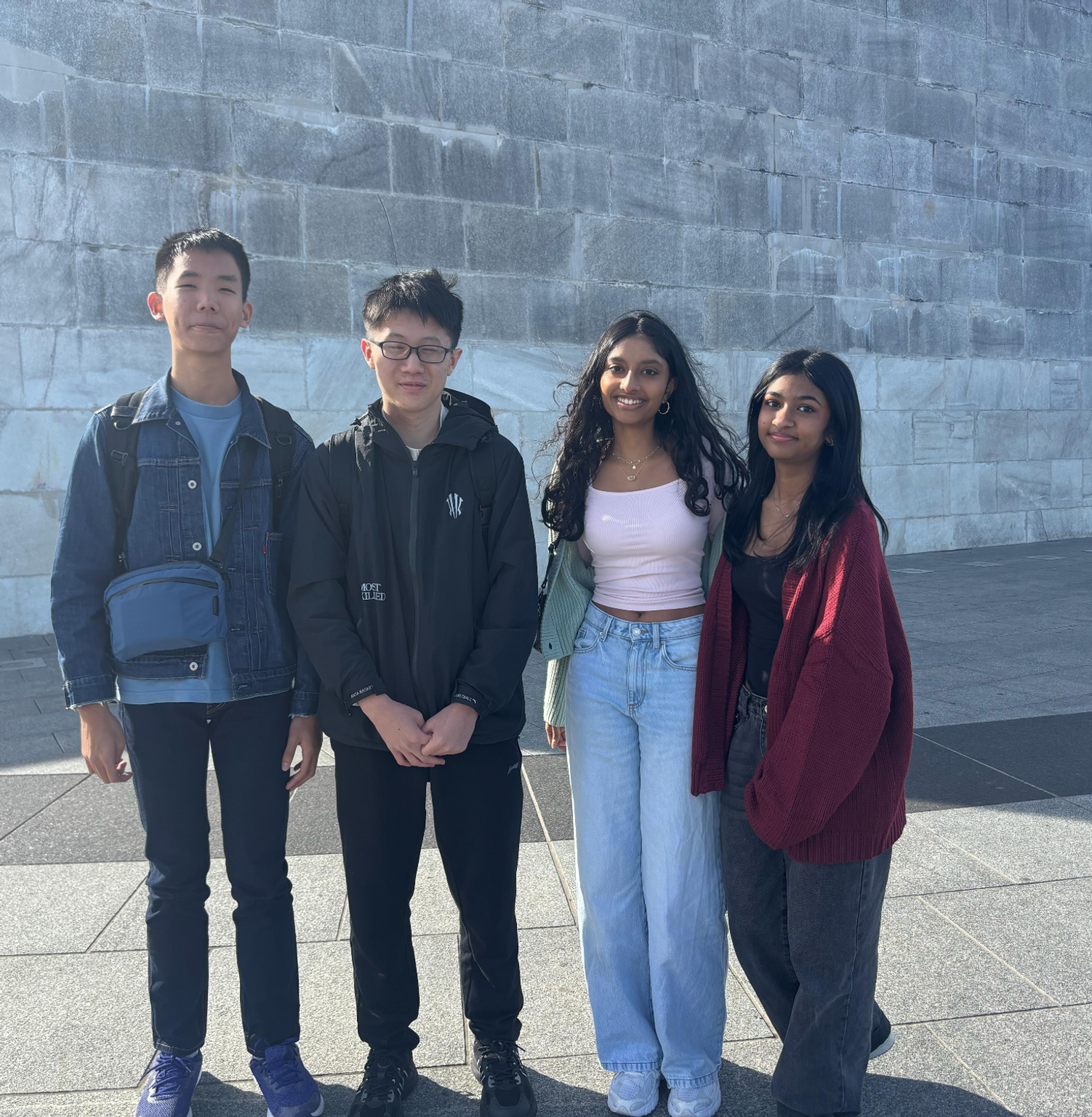
The four team members at the Washington Monument during their visit to the United States in October 2025, together with their project teammates Aditi Chalasani and Susmita Das from the Academies of Loudoun (ACL), HCI’s partner school in the United States.


