.png)


From Scepticism to Appreciation: My Lion Dance Sabbatical Journey
At Hwa Chong, Sabbatical Week gives students the chance to step into unfamiliar experiences and discover new interests beyond the classroom. Some programmes also offer students a deeper appreciation of cultural traditions by allowing them to learn through practice, performance and teamwork.
In this reflection, Matthias shares how the Lion Dance Sabbatical changed his initial scepticism into appreciation, as he learnt about the history, skills and coordination behind lion and dragon dance.
Written by: Matthias Z Toh (3P3, 2026)
For my Term 2 sabbatical, I did not place a bid and was randomly assigned to the Lion Dance Sabbatical. At first, I was filled with scepticism because I had no prior experience with lion dance and was worried that I might not enjoy the programme. However, I decided to approach the sabbatical with an open mind, and it eventually became a truly enjoyable and meaningful experience.
On the first day, we were introduced to the history of lion dance through an engaging sharing session, followed by an online quiz. I learnt about the roots of lion dance in Singapore and the different types of lions, such as the Hoksan and Foshan lions. I also gained a better understanding of how lion dance originated and how it gradually became a cherished tradition during Chinese New Year celebrations.
Soon after, we learnt how to perform the welcome ceremony as the lion head. Although the many steps were initially confusing, the student trainers explained them clearly and patiently, which helped me gradually understand the movements. Before this sabbatical, I had not realised how many roles were involved in a lion dance performance, including the lion head, lion tail, cymbals, drums and gong.

Personally, my favourite part was learning to play the cymbals. I enjoyed following the rhythm and coordinating the beats to accompany the lion dance performance. In addition, the daily performances gave us valuable opportunities to showcase what we had learnt and receive feedback on how we could improve.
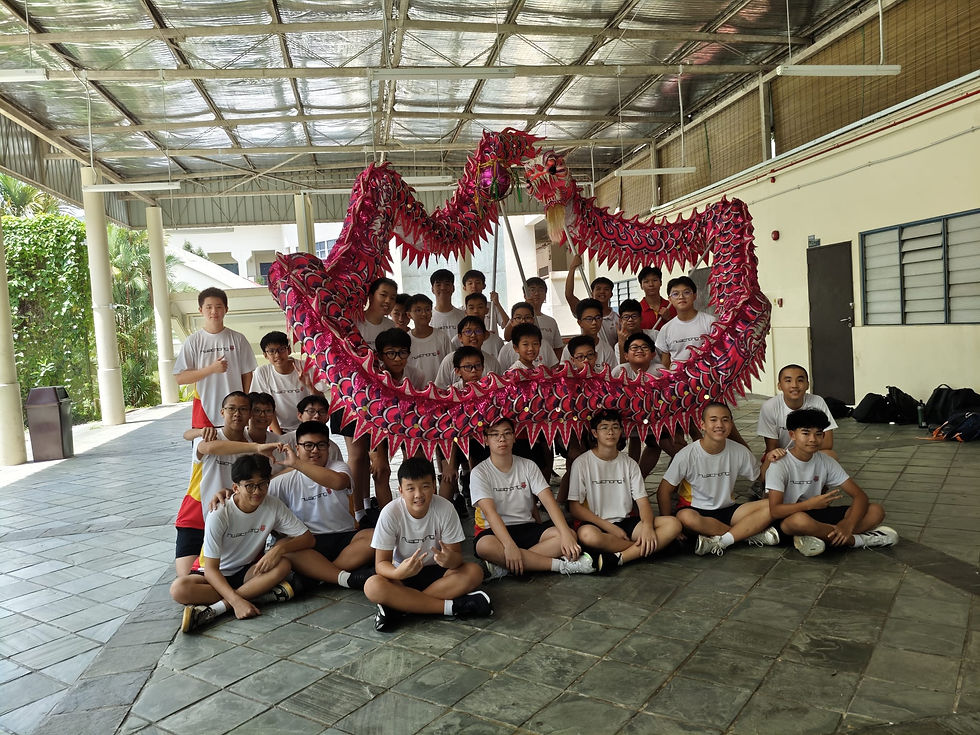
On the fourth day, we were introduced to dragon dance and learnt several basic movements. Compared to lion dance, dragon dance was far more physically demanding because it required close coordination among seven group members to control the dragon smoothly. The dragon was also significantly heavier than the lion head, requiring much more stamina and teamwork. Despite the challenge, I found it fascinating to learn how the dragon’s movements could be made to appear fluid and graceful. I also enjoyed bonding with my group members and making new friends throughout the programme.

Through this sabbatical, I gained a much deeper appreciation for both lion and dragon dance. What once seemed effortless from the audience’s perspective actually requires great skill, coordination and perseverance. Overall, this five-day experience was both fulfilling and eye-opening, allowing me to learn more about these traditional art forms while stepping out of my comfort zone.

