.png)


Interact Week 2026
- Mar 2
- 4 min read
Written by: Lee Koon Kai (25S72)
Edited by: Lei Yanyang (25S61)
Across the span of 5 days on 4-6 and 12-13 February 2026, Interact Club organised the Interact Week 2026, a large-scale event aimed at raising awareness on the plights of four vulnerable groups in the Singapore society – migrant workers, the elderly, bone marrow recipients, and persons with disabilities. This event aimed to encourage students to look beyond the surface, and show meaningful appreciation or help out these vulnerable groups whenever possible.
Day 1 saw activity booths set up in the right wing to shed light on the lives of migrant workers and dispel any negative preconceived notions held by students, as well as to encourage them to be more appreciative of the contributions made by migrant workers to Singapore’s development. The first activity booth was the Appreciation Video, where students were asked to record some words of appreciation towards these migrant workers, which would be stitched together to complete a video dedicated to these migrant workers. The second booth was the Lego booth, where students were given a time limit to build famous structures in Singapore, such as the esplanade, to simulate the construction of critical infrastructure which migrant workers are engaged in on a day-to-day basis. This acted as a simple yet powerful reminder to us of the scale of their work. Finally, the last booth was Migrantpoly – a creative twist on the famous game of Monopoly, set within the world of migrant workers. Through this activity, students gained a deeper understanding of the contributions made by migrant workers, and the experiences they go through regularly, such as sending remittances back to their home countries.

Day 2 also took place in the right wing, and involved activities directed towards raising awareness on the elderly, aimed at helping students understand the challenges – both physical and emotional – that the elderly in Singapore face, promoting patient communication whilst teaching students how to better interact with the elderly. A stamp card booth was set up in the right wing, where participants could collect stamps from activity booths in exchange for a prize. The first station was the Memory Game, which aimed to help students see through the eyes of the elderly who struggle with memory loss, like dementia. This allowed students to empathise with the cognitive difficulties and frustration faced by many elderly on a daily basis by giving them a firsthand taste of their experiences through a difficult memory card game. The second station, called “What’s that you said”, aimed to raise awareness of elderly people with hearing difficulties which hinder their day to day conversations with others. This activity involved simulating what these elderly go through everyday by wearing wireless headphones that muffled voices and attempting to communicate tasks to each other, helping students understand the importance of being patient in interactions with the elderly. Finally, in the last station, called “Huat Ah”, participants had to differentiate between dialects played in audios, helping them better communicate with the elderly who frequently use such dialects to communicate with each other.

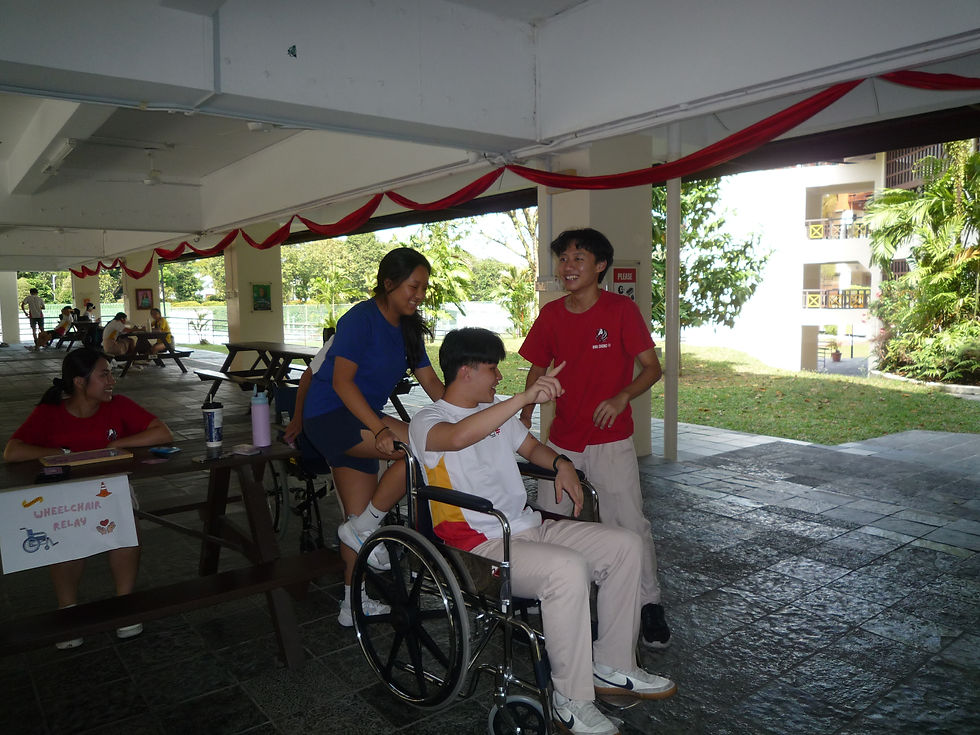
The events on day 3 were conducted at the right wing as well, shedding the spotlight on persons with physical and intellectual disabilities. These activities helped promote inclusion by helping participants empathise with the problems faced by such individuals, teaching students how to support them respectfully, and dispelling myths clouding this vulnerable group. Three activity booths were set up, with the first being the Dyslexia simulation, which involved participants trying to decipher words on paragraphs that have been specifically altered to simulate what a dyslexic person would see when reading. This allowed them to experience the difficulty experienced by dyslexic people in processing written information, promoting empathy amongst students and encouraging patience when interacting with them. The second activity booth was called “Building a Reaction Machine”, in which students experienced first-hand the challenges in communication faced by persons with disabilities using a machine created with materials like cardboard and blocks. This showcased the importance of adaptability and promoted empathy in showcasing the resilience of people with disabilities. Finally, the last activity booth was the wheelchair relay, where participants were made to navigate their way around a course on a chair with wheels attached, in order to allow participants to be in the shoes of individuals with mobility impairments. This gave students the opportunity to experience the physical obstacles faced by such individuals in their daily lives, promoting empathy and adaptability in the face of challenges.
Day 4 brought about a change in scenery, shifting from the usual right wing to the inner plaza and common room for a series of activities centred around bone marrow donation – aimed at raising awareness on the importance of bone marrow donation and encouraging more students to support this practice, or even signing up for the donation themselves. The first activity booth was the key chain making booth, where participants got to design their very own keychains based on the theme of stem cells. The second activity booth was “Marrow Pong”, where participants played an adapted version of beer pong. with the addition of small fun facts whenever they successfully make a shot, aiming to educate them on the process of bone marrow donation. Last but not least, there was also a specially designed card game, called “Marrow Mindset”, which helped students get to know more about bone marrow donation, and dispel any misconceptions they may have had about the process prior to this experience.
These activities were specially curated by Hwa Chong’s very own Interact Club, in a bid to raise more awareness on the difficulties faced by vulnerable groups in society who may have slipped through the cracks, and encourage students to be more empathetic and understanding of their plight, whilst offering much-needed assistance if possible. Needless to say, this Interact Week 2026 has been a resounding success, with many students participating in above-mentioned activities, and learning more about the different vulnerable groups and what they can do to lend a helping hand.


Comments