.png)


Walking the Tightrope: Uncovering the Diversity of Eurasian Heritage (C1 NE Learning Journey 2026)
- Mar 7
- 3 min read
Updated: Mar 29
Written by: Glynnis Lok Jia Yu (26S73)
Edited by: Lei Yanyang (25S61)
As part of their national education learning journey experience, some C1 classes visited the Eurasian Heritage Gallery to learn more about the Eurasian community and multiculturalism in Singapore. In 1511, the first Portuguese arrived in Singapore, followed by the Dutch and the British. The European men married the local women, and their children became the first of the Eurasians.
Stepping into the tour, we were first brought to an air-conditioned gallery, filled with relics, pictures and stories. In particular, a wall displaying the family trees of various Eurasian families on them highlighted the distinctive ethnic background and diverse heritage of the Eurasian community, shedding light on their extensive and multifaceted history.

While many recall the brutal mistreatment of the Chinese under the Japanese Occupation during World War II, but not many are aware of the similar conditions faced by the Eurasians back then. Descended from both locals and European settlers, the Eurasians had blurred identities. The Japanese believed they were spies and mistreated them, deporting them to the isolated and rural Bahau, breaking up communities and sending them away from their homes in Singapore. On the other hand, the British also did not treat the Eurasians as their peers due to their mixed heritage. Beyond external perceptions, the community themselves did not know where their identities stood in Singaporean society.
Despite all their struggles, however, Eurasians still contributed selflessly to Singapore’s development. During the Second World War, despite the imminent surrender of British forces in Singapore, a brave group of six Eurasians placed themselves in the line of fire to go back to work one last time, sending soldiers’ last messages back to headquarters in Britain.
Another Eurasian girl, seeing the miserable conditions of the Prisoners-of-War, risked her life to deliver packages of food to them routinely, bringing even just a small glimmer of hope into otherwise desolate conditions. As we listened, we slowly discovered more and more about the history of the Eurasian community — an aspect not covered in our day-to-day History lessons.
With each passing moment and each uncovered story, light was shed on the intricate interwovenness of Eurasian heritage with Singapore’s development. For example, Edmund William Barker, a Eurasian lawyer, was Singapore’s Minister of Law from 1964-1988. He drafted the Separation Agreement for Singapore and Malaysia, making an indelible mark on Singapore’s history and development. It is jarring – and perhaps overdue for reflection – how the contributions of many Eurasians who played a significant part in our history are not widely known.
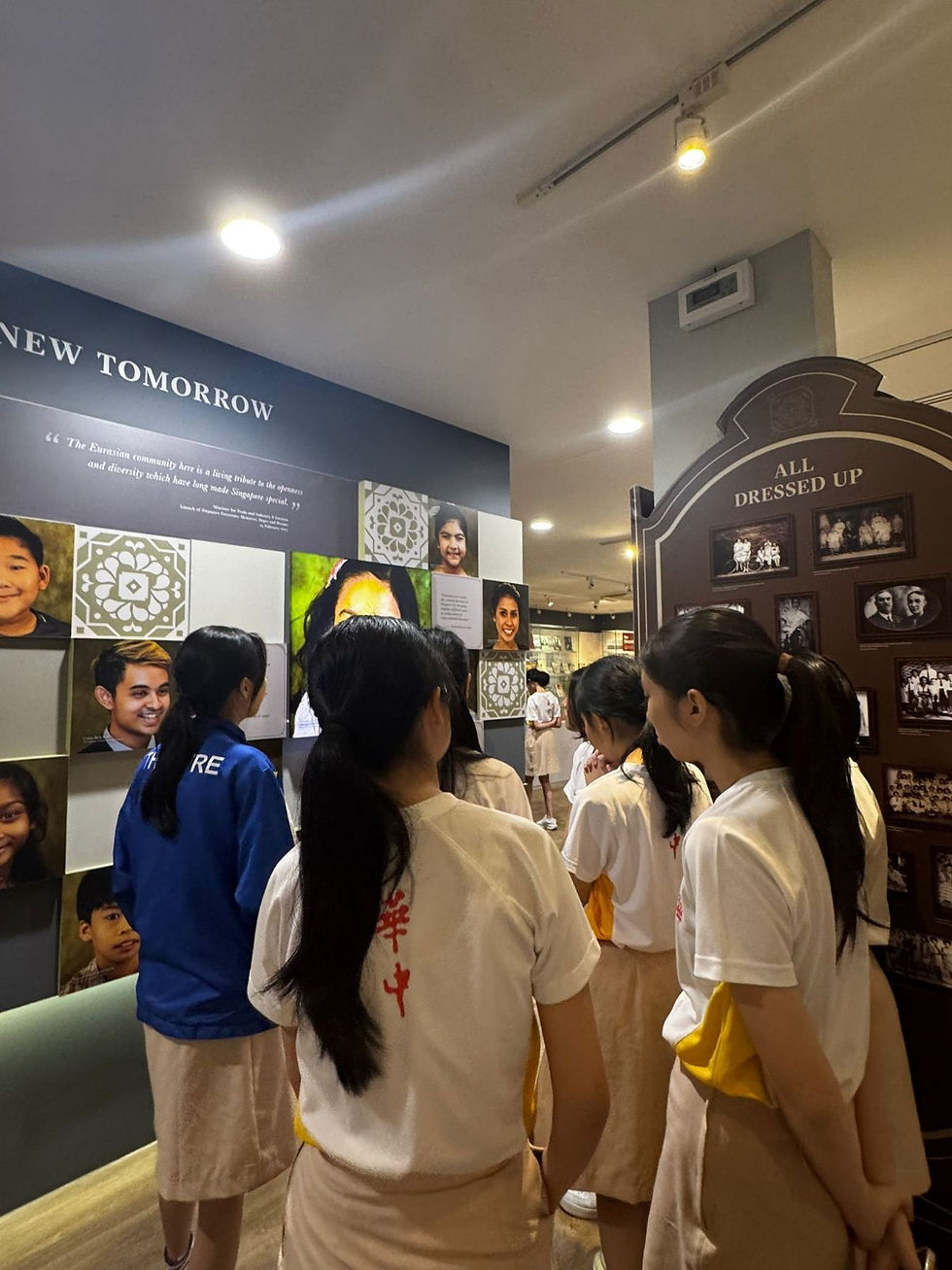
Thereafter, we headed into a hall for the second half of the session, where we learnt a traditional Eurasian folk dance called Jinkli Nona. The dance is often performed at various events, and is a hallmark of Eurasian culture. It involves a pair of dancers, with an energetic beat, and repetitive and simple movements. Though the dance session began with a touch of awkwardness, laughter soon filled the hall as students deepened their understanding of Eurasian cultural traditions amidst fun and joy.
Afterwards, we had the opportunity to try Sugee cake, a traditional Eurasian confection. It is a dense and moist cake, made with semolina, butter and ground almonds, traditionally consumed during festive occasions. In addition, we learnt more about other Eurasian dishes, including Curry Debal, a popular food both within and outside the Eurasian community. Otherwise known as ‘Devil’s Curry’, this dish is usually made around Thanksgiving, when leftovers are abundant. The speaker explained that the dish’s signature tang traditionally came from leftover meat that had begun to ferment or sour. While modern health standards have replaced this practice with fresh ingredients, the distinctive sour undertone remains a defining characteristic of the recipe.
The dish serves as a perfect metaphor for the tightrope the Eurasian community walks – a delicate mix of characteristics from both European and Asian lineages. Whether it is European holidays celebrated with Asian flavours, or a distinct blend of East and West in dance, these cultural traditions highlight the uniqueness and diversity of Eurasian culture. In Singapore’s multicultural landscape, Eurasians are recognised as one of the four predominant ethnic groups despite their small numbers. It is a testament to their resilience that such a compact community has preserved its unique heritage and identity while integrating deeply into Singapore’s social fabric.


Comments